

In Part 2 of Builders Behind the Launches, we’re highlighting four BuildHop founders creating clearer, more dependable ways to design, explore, find work, and use AI.
Most frustrating problems do not announce themselves as startup ideas.
They show up as a tool that is more complicated than the task requires. A campsite search that does not account for what you actually want to do. A job hunt that becomes a maze of applications and rejections. An AI workflow that produces something useful once, then disappears into a pile of disconnected chats.
The founders in this edition kept noticing those moments.
Welcome back to Builders Behind the Launches, a recurring BuildHop series highlighting the people and stories behind the products launching in our community.
For Part 2, we are featuring four founders: Luke, Todd Embleton, Justin Hammon, and Melvin Rook.
Their products cover design, camping, job searching, video, and AI workflows. But beneath that variety is a shared instinct:
When friction repeats often enough, it is probably trying to tell you something.
Luke, LogoLattice
Luke builds in a familiar corner of the internet: the space between what software can do and how awkward it can feel to use.
He is drawn to problems involving tools that should feel visual, editable, and playful but are often buried under complexity.
That instinct led him to LogoLattice, a grid-based design tool for drawing structured shapes and editing SVGs. Luke sees it less as a replacement for professional design software and more as a gateway into design—a way to make creating and experimenting with logos feel approachable rather than intimidating.
The idea fits a pattern across his work.
Why is this harder than it needs to be?
Luke’s products often begin with what he describes as a slow accumulation of annoyance. He found himself using tools that were either extremely powerful but felt like flying a plane, or simple enough to start with but fell apart as soon as someone tried to do something interesting.
Eventually, he stopped trying to master the existing tools and began building the versions he wished existed.
But one of his biggest lessons has been that building something good is not necessarily the hardest part.
Getting someone to understand the product’s value within a few seconds is harder.
Users do not care about features in isolation. They care about whether their problem is solved easily. AI does not change that. As Luke points out, AI is not magic dust that can be sprinkled over every product. A useful system should already make sense and stand on its own.
The signals he trusts are similarly grounded in behavior.
Someone returning to a logo and treating it like a living file. A person relying on one feature and referencing another part of the product. A user adapting the tool to their own workflow instead of following the exact path Luke originally imagined.
Those moments show that the product is becoming more than a demo.
Luke is currently working through the difficult space between “this is interesting to try” and “this is something I rely on.” Getting someone to the first useful moment can be relatively easy. Giving them a reason to return is much harder.
His advice to first-time builders follows naturally:
Your first vision of a product will be wrong in some way. You will build for what you think people need, not necessarily what they do when they are confused and looking for a quick solution.
The “aha” moment is not a feature that can simply be optimized and added to a checklist. It is a small, nuanced feeling created when the whole product helps someone reach a useful outcome.
If that value feels difficult to explain, the answer is not always a better pitch.
Sometimes the product still has more simplification to do.
What is LogoLattice?
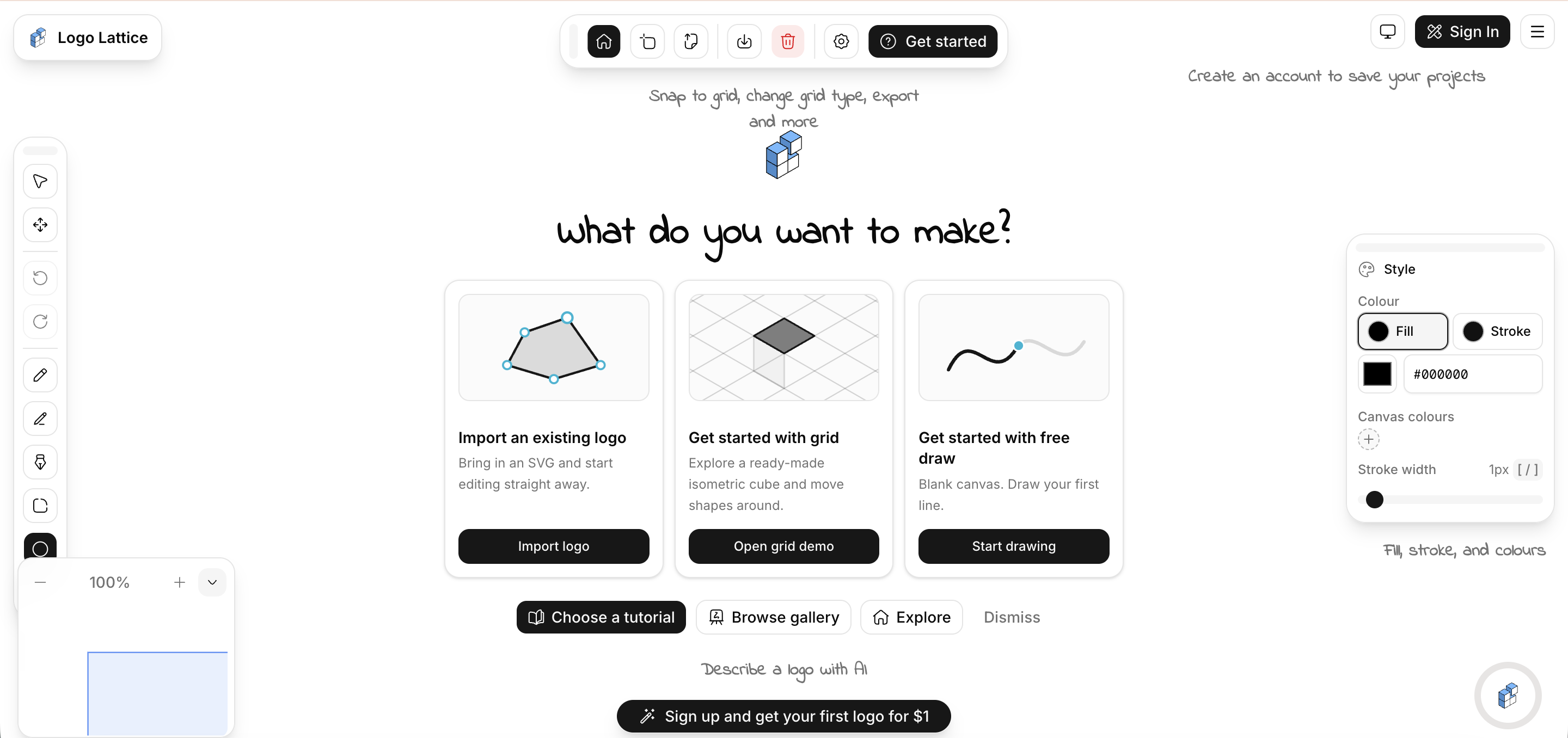
LogoLattice is a grid-based logo design tool that helps users draw structured shapes, experiment with visual ideas, and edit SVGs through a more approachable creative workflow.
It is designed as a gateway into logo creation: structured enough to help ideas take shape, but accessible enough that users do not need to master a complicated professional design suite before they begin.
Snap to the grid, work freehand, reshape elements, and keep refining your logo as a living design rather than a one-and-done export.
Todd Embleton, Camprtron
Todd Embleton has been around computers and programming since the early days of the internet.
His interests have remained remarkably consistent: building tools that improve processes, solve productivity problems, and make difficult searches easier for the person on the other side.
That instinct led him to Camprtron, a niche campsite-search platform built around an important observation:
People are rarely searching for just a campsite.
They are looking for the right base for a particular trip.
A camper might want to stay near a favorite activity, within a reasonable drive of the site, and close enough to a dependable water source. Traditional campsite directories do not always make those practical details easy to compare.
Camprtron is Todd’s attempt to make that search more useful.
The platform includes more than 12,000 campsites and helps users find locations close to the activities they want to do. Searches can account for sites within a 30-minute drive of an activity and within 300 feet of a perennial water source that can be filtered for drinking or cleaning.
Instead of beginning with a broad destination and leaving travelers to research everything else separately, Camprtron connects the campsite to the experience surrounding it.
Todd’s approach to building is practical. He likes products that remove repeated work and help users make better decisions without forcing them to assemble the answer themselves.
One of his first signs that his marketing was beginning to work came when people he did not know started signing up. It was not a dramatic growth milestone, but it was meaningful: the product had begun reaching beyond his immediate circle.
Like many founders, Todd has found that creating the product and getting it in front of the right people are very different challenges.
The area he is most focused on now can be summarized in three words:
Marketing, marketing, marketing.
His advice to first-time builders is to verify an idea before going all in.
AI-assisted development can make building faster, but it does not make the cost of choosing the wrong problem disappear. Even a vibe-coded product requires time, attention, refinement, and money before it is ready to show the world.
That is why customer research and marketing should begin on day one.
They are not activities that come after the product. They are part of determining what the product needs to become.
What is Camprtron?
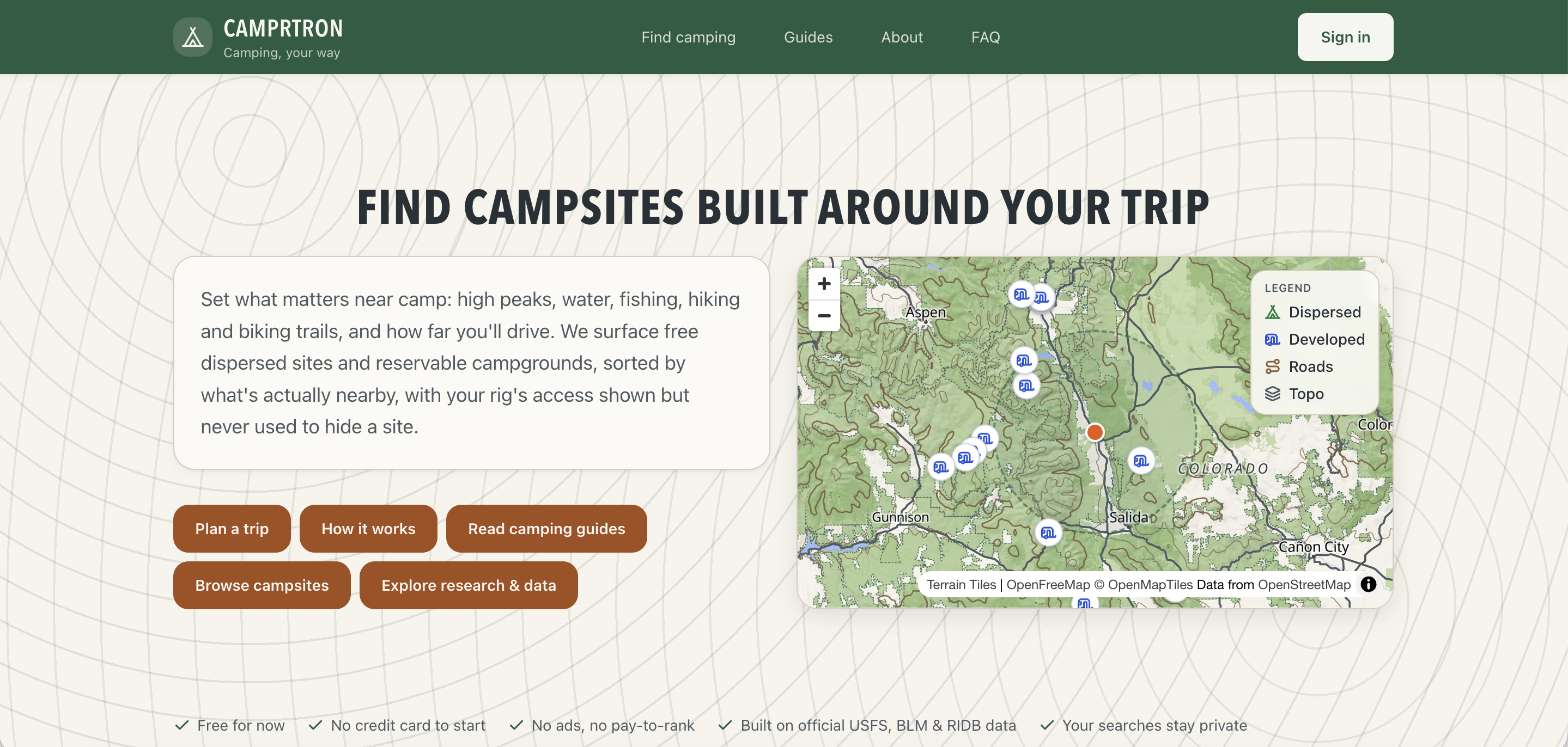
Camprtron is a campsite discovery platform built around what travelers want to do, not merely where they want to sleep.
It helps campers search more than 12,000 campsites using practical criteria such as nearby activities, driving distance, and proximity to perennial water. The result is a more useful way to find a campsite that fits the trip someone is actually planning.
Justin Hammon, RoleNavigator
Justin Hammon’s builder story starts long before his current products.
At 16, when the internet itself was still new to him, he launched a website design company called Designs On Demand. He found a customer in another state and built a website for them.
From there, he stayed close to technology through ten years at Verizon Wireless and later at a GovTech SaaS company.
Then, in November 2025, he was laid off.
Justin responded by building a tool to help himself find another job. That tool became RoleNavigator and, more importantly, changed the way he thought about building.
He realized that his ability to create his own tools was a form of resilience.
RoleNavigator is designed to turn job seeking into a system. That matters in a market where layoffs and reorganizations have placed more experienced technology workers into increasingly crowded applicant pools.
More applications create more filtering, more automated rejection, and more people hearing nothing at all.
The hardest part of job seeking is not simply finding listings.
It is maintaining momentum through repetition, uncertainty, applications, follow-ups, and rejection.
RoleNavigator is Justin’s attempt to reduce that burden.
He is also building CapQuick, a privacy-conscious captioning tool inspired by the growing importance of video on platforms such as X. CapQuick adds captions to videos without uploading user data to the cloud and without requiring a monthly subscription.
Both products reflect the kind of tools Justin likes to build: straightforward software that makes a difficult or annoying task easier.
One of the biggest changes in his thinking has been his relationship with speed.
He once treated development like a race. He still believes speed to market matters, but he no longer sees it as the deciding factor in whether a product succeeds.
A good idea can be improved slowly, deliberately, and continuously.
Justin’s strongest signal is not a single revenue milestone. It is the continued evidence that the problem matters. Every time another layoff appears in the news, the need for tools that help people navigate the job market becomes harder to ignore.
The challenges he is working through now are onboarding, acquisition, retention, and finding better ways to gather useful feedback from users.
Those challenges are familiar because they begin where the code ends.
Justin’s advice for first-time builders is direct:
Just go for it.
The doubt does not disappear when you start. It may not disappear after the first customer pays, either.
If uncertainty is going to remain, you might as well be building while it is there.
What is RoleNavigator?
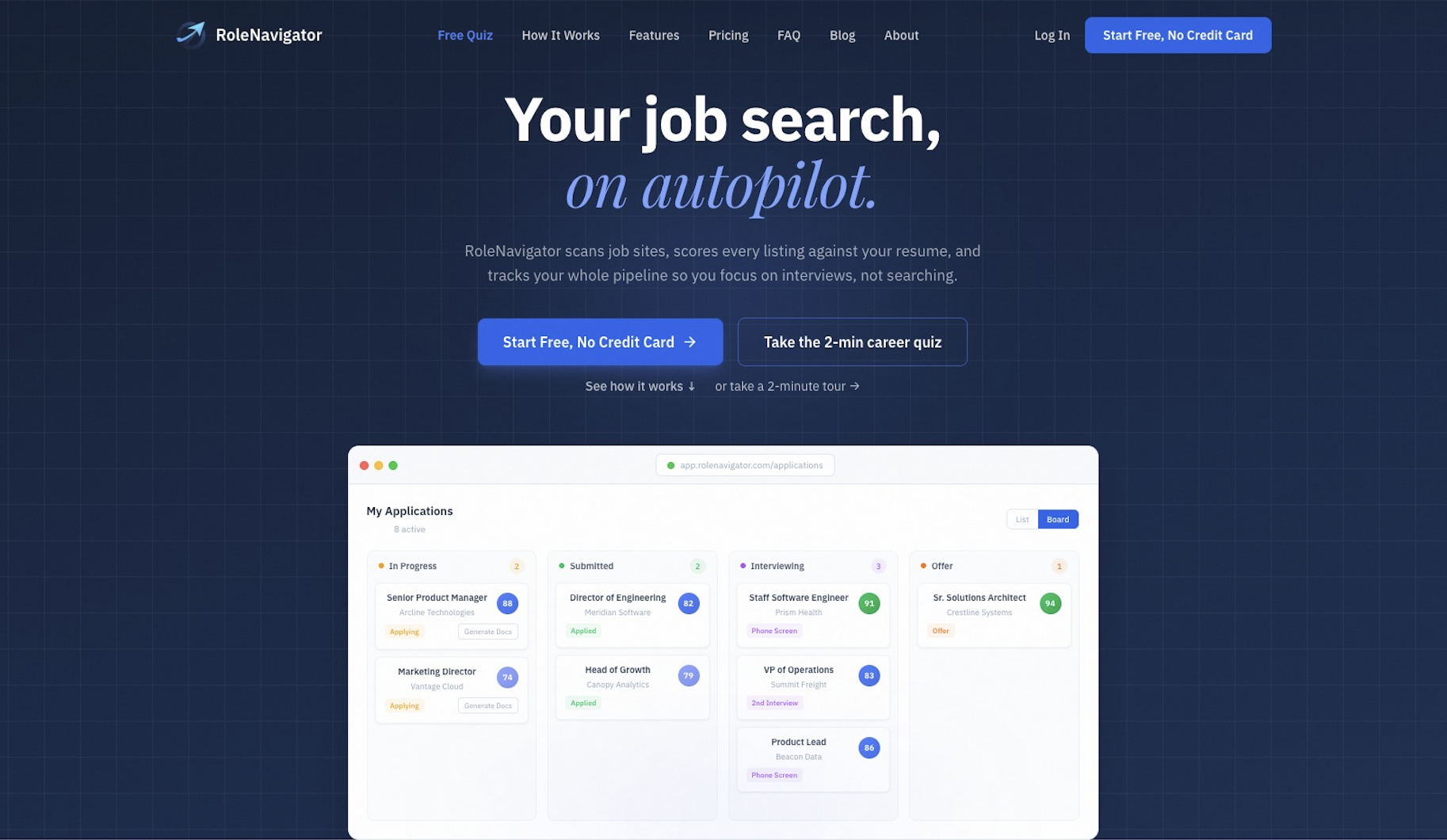
RoleNavigator helps job seekers organize and automate their search.
It turns applications, opportunities, and follow-ups into a clearer system so users can spend less energy managing the process and more energy finding the right role.
Melvin Rook, PromptPlanner
Melvin Rook started working hands-on with technology at 15.
Over time, his focus expanded from writing individual systems to building teams, technical architectures, and companies around them. He is most interested in problems where the underlying complexity is high but the outcome should feel simple to the user.
Distributed systems. Automation. Marketplaces. Platforms. AI workflows. Digital distribution.
The common thread is not a particular technology.
It is leverage.
Through Techflection, Melvin works as a fractional CTO for startups and scaleups, helping companies make decisions about architecture, hiring, engineering culture, AI adoption, and product delivery. He is also involved with VaultN, which is building enterprise infrastructure for digital distribution in gaming.
His BuildHop launch, PromptPlanner, comes from a more personal frustration.
As AI became part of more people’s daily work, Melvin noticed how improvised the process remained. Useful prompts disappeared. Good ideas became trapped in old chats. Workflows were difficult to repeat. Each new conversation started from scratch.
His conclusion was that AI needs a planning layer.
Not another chat window, but a way to turn intent into a repeatable process.
That insight reflects a lesson Melvin learned much earlier in his career. At the HAR2009 event, his team needed to process thousands of visitors using QR-code tickets.
The original webcam-based idea was too slow, so he replaced it with a proper scanner, wrote the device integration, and built a check-in system capable of surviving real event pressure.
The right solution was not the fanciest one.
It was the one that worked when reality arrived.
Melvin once believed more strongly that excellent technology would naturally produce a successful product and business. He still cares about architecture, performance, scalability, and technical quality, but his definition of success has broadened.
Users do not adopt architecture.
They adopt clarity, timing, trust, and solutions to problems urgent enough to matter.
His strongest signals reflect that shift. When users began describing projects such as Phyzle and Diversia through their own use cases—imagining how a teacher might use them or comparing them with games they already enjoyed—he knew the ideas had landed.
People were no longer only saying that the technology was interesting.
They were placing it inside their own lives.
Melvin is currently working through positioning for PromptPlanner. It could serve founders, marketers, developers, consultants, students, teams, or enterprises.
That flexibility is technically exciting, but it creates a product challenge.
When something can become many things, the difficult work is deciding what it should become first.
His advice to builders is to release early and often. A useful product is not created by thinking harder in isolation. It develops through contact with real users who correct assumptions.
Technical maturity matters—but only after the product is solving something people genuinely need.
What is PromptPlanner?
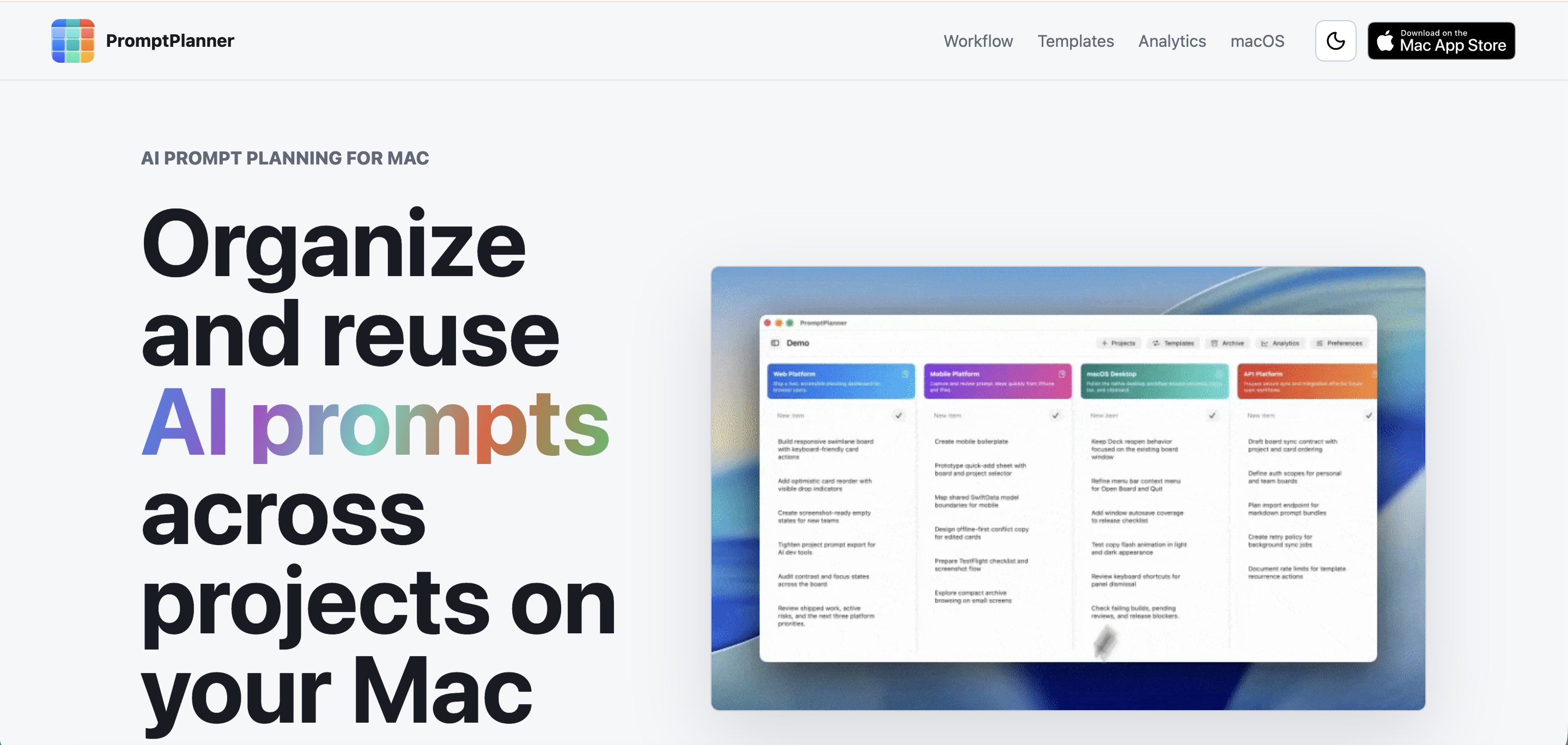
PromptPlanner is a Mac app for organizing and reusing AI prompts across projects.
It gives AI work a planning layer so users can preserve ideas, structure prompts, iterate deliberately, and turn one-off conversations into repeatable workflows.
The Pattern Behind the Products
Luke, Todd, Justin, and Melvin are not building the same kind of product.
One is making logo design easier to explore. One is improving how campers find the right place to stay. One is turning the job search into a more manageable system. One is making AI workflows more deliberate and repeatable.
But their founder stories begin in a similar place.
Something kept being harder than it should have been.
For Luke, that means questioning why capable creative software so often becomes awkward and inaccessible.
For Todd, it means helping campers search according to the experience they want, not simply the place where they plan to sleep.
For Justin, it means turning personal uncertainty into a system that can help someone keep moving.
For Melvin, it means making complex technology reliable, repeatable, and useful under real-world conditions.
None of those lessons begins with a feature list.
They begin with observation.
The repeated search. The tool someone abandons because it is too complicated. The workflow that succeeds once but cannot be reproduced. The person who signs up unexpectedly. The user who returns and makes the product part of their own process.
Those are the moments behind the launch page.
They show why a product exists, where it still needs to improve, and what its founder is learning by putting it into the world.
That is what we want to keep highlighting through Builders Behind the Launches: people paying attention to recurring friction, testing their assumptions, and turning ordinary frustrations into useful systems.
You can explore more Founder Spotlights on BuildHop and discover what builders are making, one hop at a time. ✨
Want to be featured in our next article?
Join the Founder Spotlight today, with or without a launch on BuildHop.
