
Logo Lattice
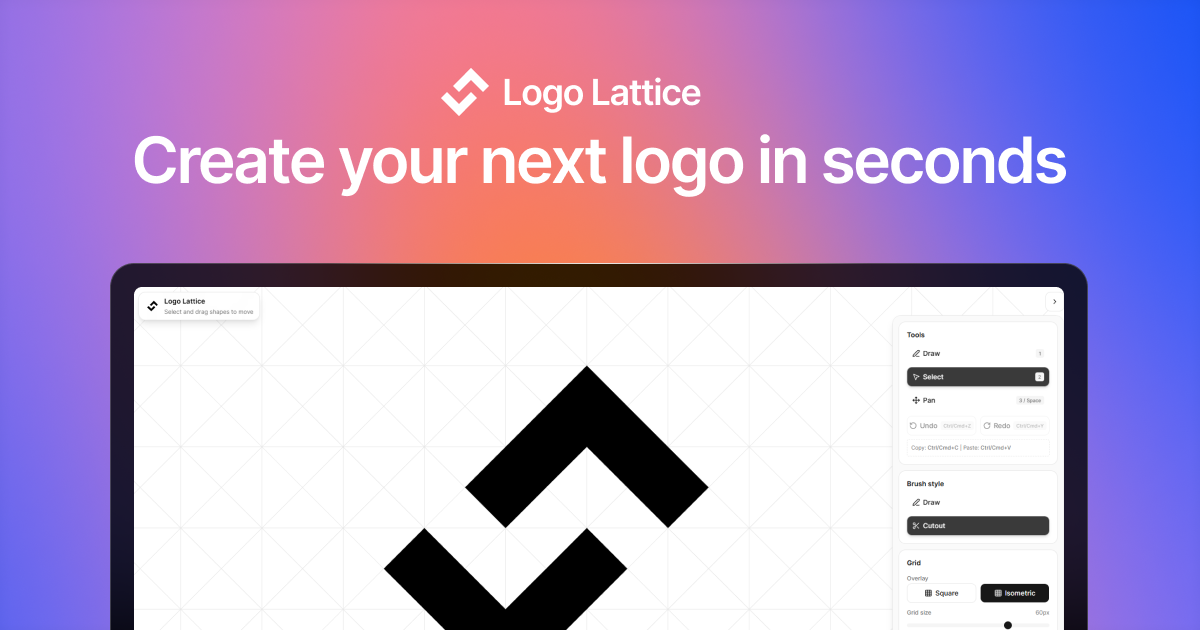
Create your next logo in seconds, not hours. Snap to grid, freehand, shapes and more 🔥
https://logolattice.com/Loading BuildHop

Create your next logo in seconds, not hours. Snap to grid, freehand, shapes and more 🔥
https://logolattice.com/Question 1
I'm a software developer that keeps ending up in the same corner of the internet: tools that combine design, code and structure. I like problems where the answer isn't just "add more features" , but "why is this so awkward in the first place". Most of what I build tries to do two slightly conflicting things at once: give people structure, but not suffocate them with it. If something feels like it should be visual, editable and a bit playful, but generally is buried under complexity, that's where I enjoy poking around!
Question 2
I'm building a few things at the moment, all to automate the parts of life I find boring. I enjoy tinkering with design and logos for my apps, so I am building Logo Lattice: a grid based tool where you can draw structured shapes and edit SVGs. It has AI in there, but mostly as a gateway to ideas rather than full design. I hate marketing, and I can never make myself do it. So I'm also building Plume, which surfaces a way to manage most socials, along with AI integrated analytics of what content works for your accounts on which platforms. And I hate spending my time doing things that aren't interesting. So rather than spend a few hours a year doing my self assessment, I'm building Unaccountable, an automated system for filing taxes for people that hate company bureaucracy (seriously, I think it has no place and should just go in the bin).
Question 3
Honestly, it's basically a slow accumulation of annoyance. Using tools that were either insanely powerful but felt like trying to fly a plane, or super simple but fell apart as soon as you tried to do anything interesting. I stopped trying to "learn the tools" and started building versions of them I wish existed.
Question 4
I used to think building something good was the hard part. Turns out getting people to feel your vision within seconds is much harder to achieve. I also used to overestimate how much people care about features. In reality, they just care about whether their problem is solved easily. More than anything, I've learned that AI isn't magic dust you sprinkle over everything. It works best when the system already works and stands up on it's own.
Question 5
I think there's a specific kind of signal I trust more than analytics. It's when someone uses something slightly wrong but in a way that's actually better than what you designed. Like someone coming back to a logo and treating it like a living file, rather than a one and done. Or people using one feature of your app, and referencing another part, but realising there's no link between the two, so it's all open to interpretation. Those moments feel like the product is escaping your initial vision, and that's a gold mine for enhancements and improvements.
Question 6
I'm currently stuck in the awkward middle ground between "this is cool to try" and "this is something I rely on". Right now, getting people to the first moment is easy. Getting them to stick around and come back is significantly harder. I'm also still figuring out how much control to give versus how much to automate. If you give people too much structure, it feels rigid. Too much AI and it feels like you're not really in charge of what you're making. I think there's a sweet spot in the middle of all of that, somewhere...
Question 7
Your first vision of a product will be wrong in every single way. You'll build what you think people need, not what they actually do when they're slightly confused and looking for a quick fix. You'll aim for the 'aha' moment - remember though, it isn't a feature you can optimise and integrate. It's a tiny nuanced feeling. Every feature you integrate is aiming at supporting users to reach that point. If something feels weirdly hard to explain, that's usually a sign the product still has some simplification to do, not that you need a better pitch.