

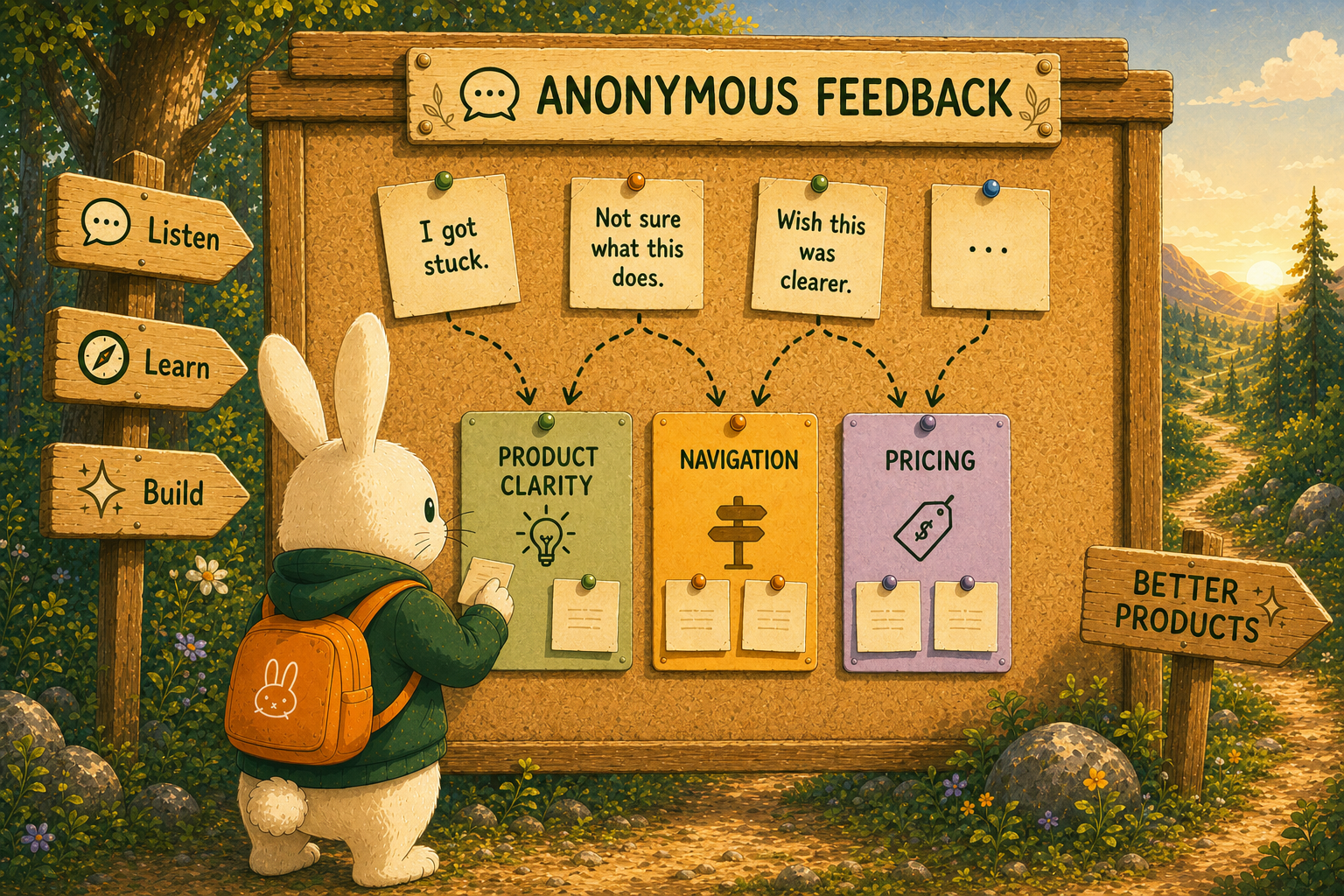
Asking people what they think of your product can be surprisingly complicated.
Even when someone genuinely wants to help, they may soften the confusing parts, add a compliment before a criticism, or avoid saying something that feels too blunt. Not because they are being dishonest. Giving honest feedback can simply feel a little awkward when your name is attached to it.
Remove the name, and people often feel freer to share the sentence they were already thinking.
We recently released an anonymous feedback widget built on top of a feedback system that has been anonymous from the beginning. Everything below comes from watching what people choose to share when they know their feedback is useful, but their identity is not part of the exchange.
What anonymity gives you
Anonymous feedback lowers the social cost of being honest.
People may tell you that a feature was confusing, that they did not understand the landing page, or that they left because they could not figure out what to do next.
That last kind of feedback is especially valuable.
Most people do not enjoy admitting that they did not understand something. But confusion does not mean the user was not smart enough. It usually means the product did not communicate clearly enough in that moment.
And that is good news, because confusing moments can be found, understood, and fixed.
What anonymity cannot give you
Anonymous feedback comes with a few trade-offs. None of them make it less useful, but knowing about them helps you interpret it with a little more care.
Follow-up. Someone may leave the most useful sentence you have read all month, but you cannot ask what they meant or invite them to explain further (but you can ask other founders what they think about the feedback via the founders feed!)
Context. You may not know whether the feedback came from your ideal user, a longtime customer, or someone who discovered the product five minutes ago.
Tone. Some people become more direct when their name is removed. Most anonymous feedback is still thoughtful, but the occasional sharp comment can sting, especially when you care deeply about what you are building.
Weighting. With named feedback, you gradually learn whose perspective tends to be especially relevant. Anonymous comments arrive without that history, so you have to find other ways to decide what deserves attention.
You cannot completely remove these limitations. You can, however, design your collection and analysis process around them.
Collect feedback while the experience is still fresh
Timing may be the biggest factor in the quality of the feedback you receive.
Feedback requested a week later is based on memory. Feedback collected during the experience is based on what someone is noticing right now.
Memory tends to smooth over the details. In-the-moment feedback is more likely to tell you which button was unclear, where someone became stuck, or what they expected to happen next.
Try to place the invitation near the moment you want to understand. That might be:
On the page where people commonly get stuck
Immediately after they complete an important action
Near the point where they appear to abandon a process
Keep the request lightweight. One thoughtful question will often teach you more than a long survey.
Open text can also be more useful than a rating alone. A three-out-of-five score tells you that something was imperfect. “I could not tell what this page was asking me to do” gives you somewhere to begin.
It also helps to explain anonymity plainly. People share more openly when they understand that their name, email, and account are not attached to what they write.
And whenever possible, do not require an account before someone can leave feedback. The people who leave before signing up may be the exact people who can show you what is preventing others from continuing.
Look for themes, not just individual comments
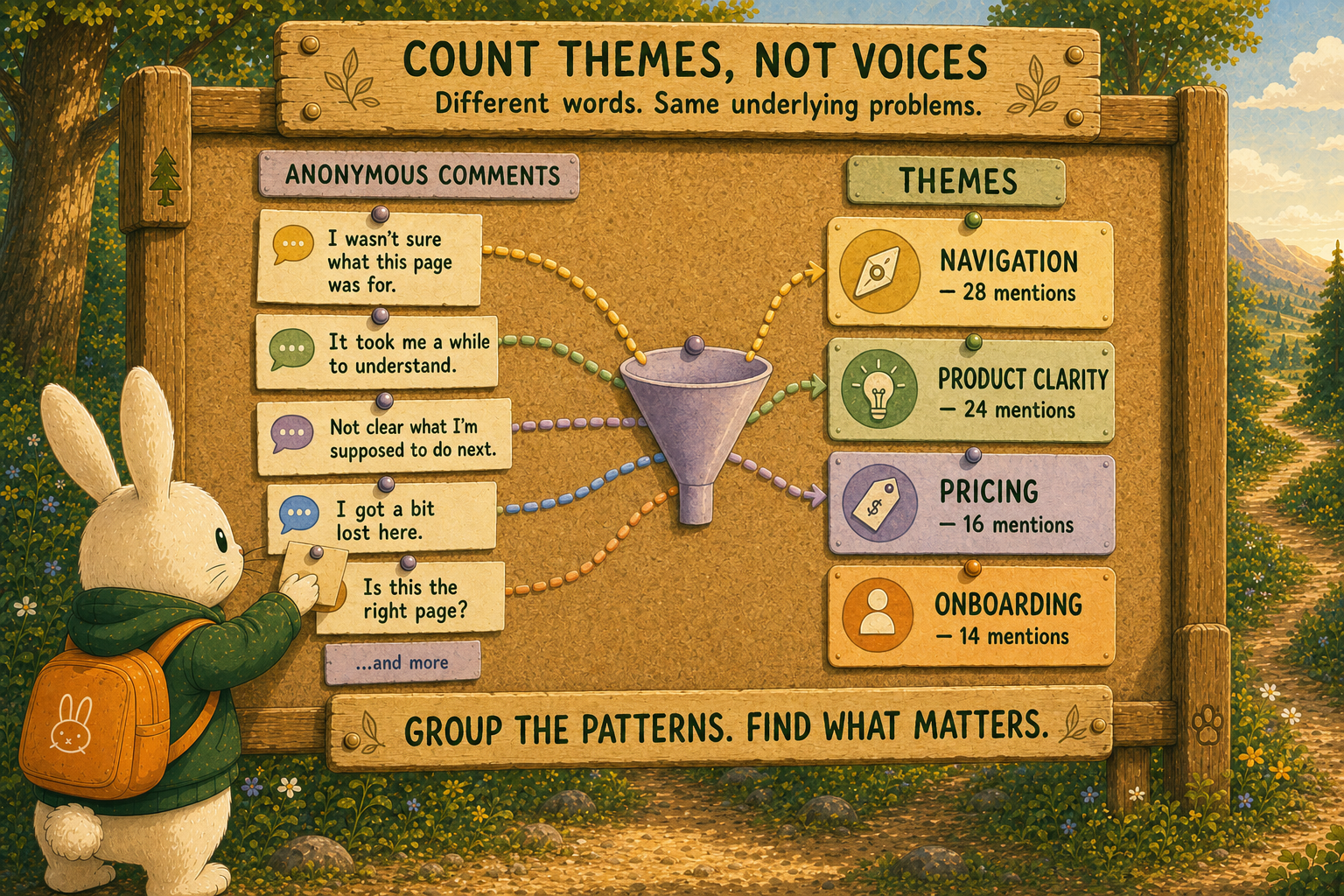
Reading anonymous feedback can feel a little like standing in the middle of a room where everyone is talking at once.
The goal is not to react to every sentence. It is to notice which ideas keep returning.
Start by grouping comments according to what they are about:
Onboarding
Pricing
Navigation
Product clarity
Missing information
A specific feature or action
Try not to begin with whether the comment feels positive or negative. A frustrated comment and a gentle comment may still be describing the same underlying problem.
Once comments are grouped, look at repetition.
Ten people mentioning pricing confusion is a clear pattern. One strongly worded comment about pricing may be an isolated reaction, or it may be the first visible sign of something other people experienced silently.
You do not have to decide immediately. Let patterns develop.
Pay attention to specificity
Without a name or user history, specificity becomes one of your best signals.
“This is bad” does not tell you very much.
“I clicked the button twice because nothing appeared to happen after the first click” gives you a moment to investigate.
Specific feedback is generous. Someone took the time to describe what happened rather than simply report that they disliked it. Even when the wording is direct, there may be something useful underneath it.
The most helpful response is usually curiosity:
What were they trying to do?
What did they expect to happen?
What happened instead?
Those questions can turn a sharp sentence into a practical product improvement.
Notice when people describe the same problem differently
This is one of the trickier parts of analyzing feedback.
Several people can experience the same friction and describe it in completely different language.
One person says the page was confusing. Another says they were not sure what to click. Someone else says it took them a while to understand. A fourth asks whether they are on the correct page.
Those may not be four separate issues. They may all point to the same navigation or hierarchy problem.
Try to tag the experience underneath the wording, rather than relying only on the exact words people used. Otherwise, one meaningful pattern can become scattered across several smaller categories.
Pair what people say with what they do
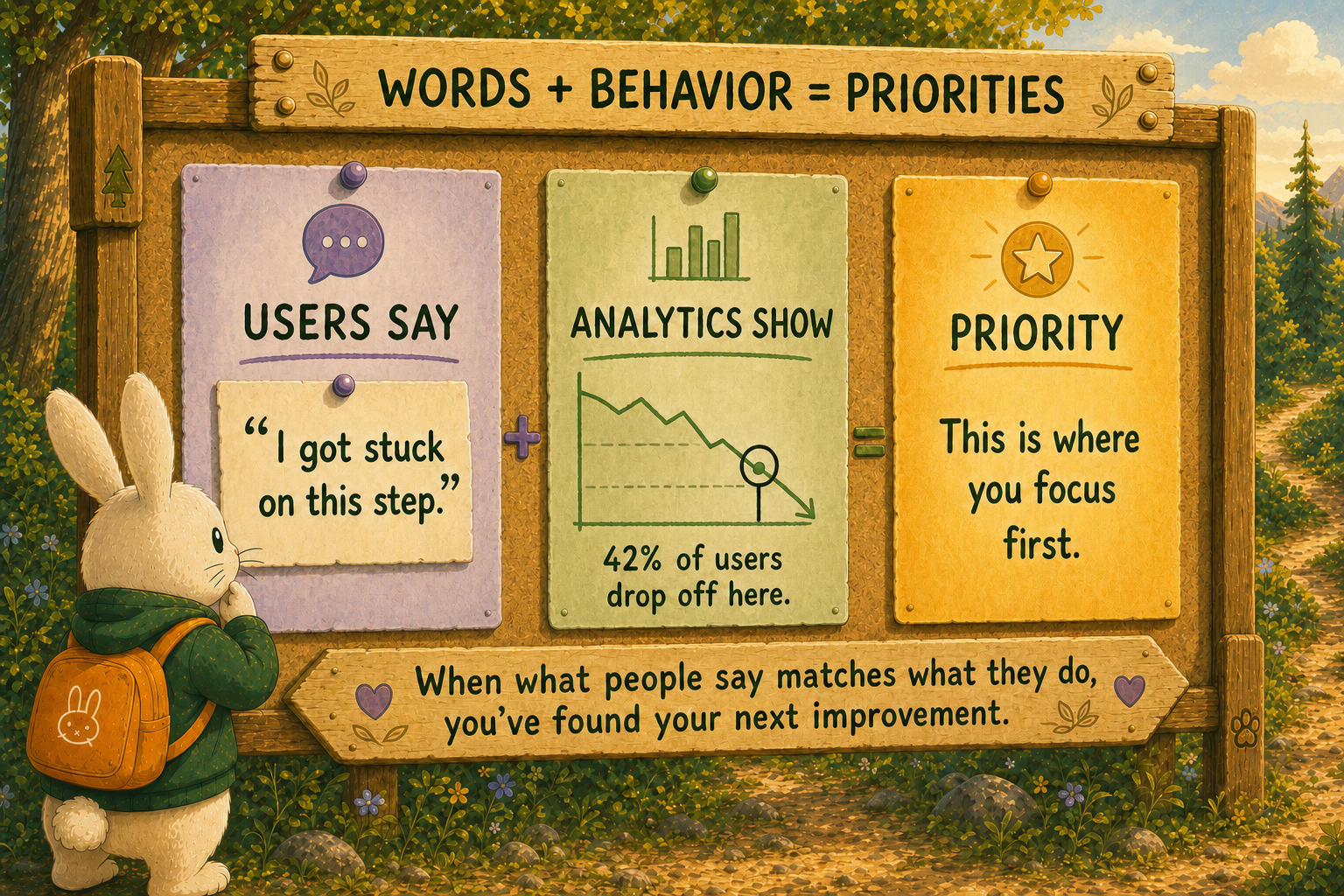
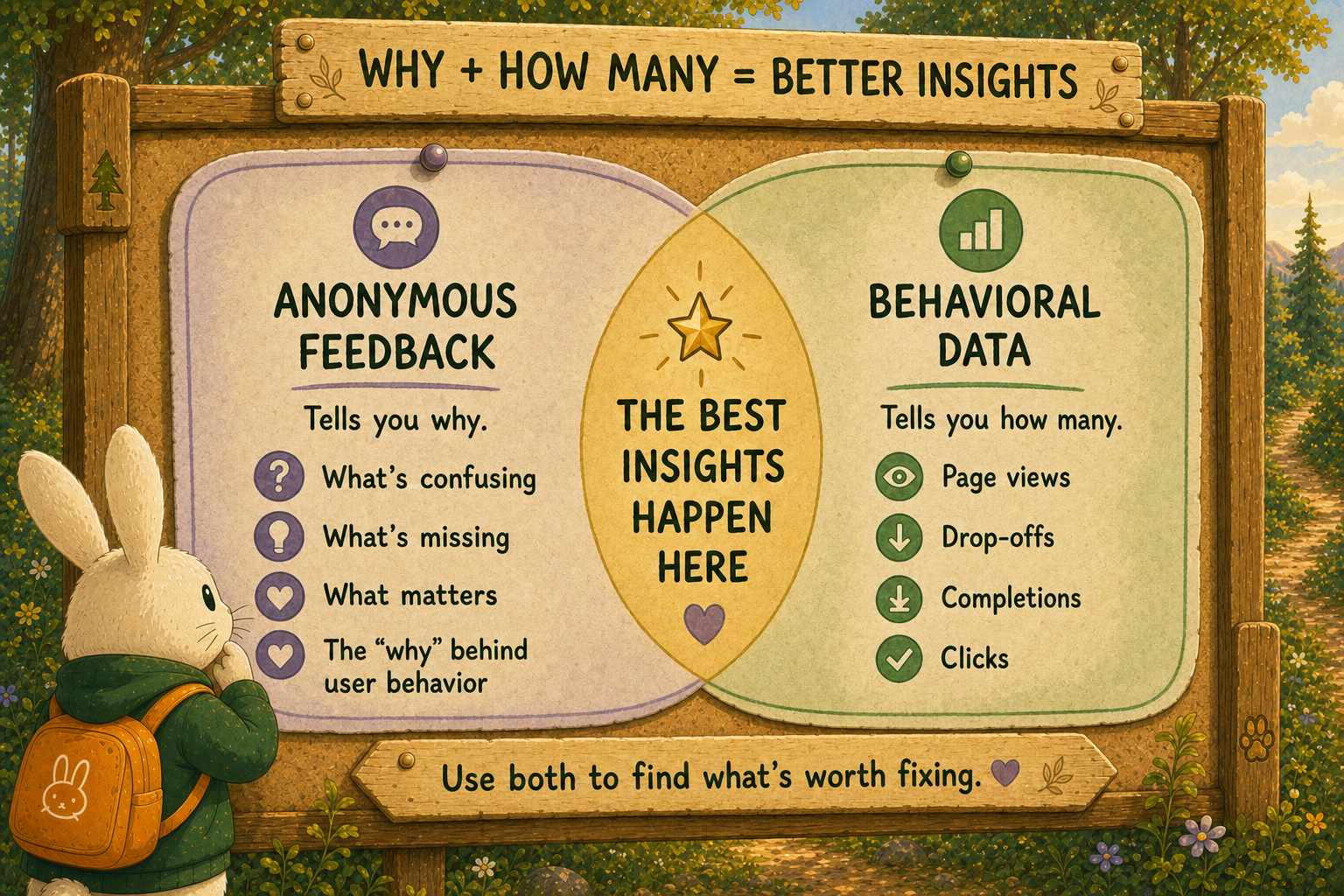
Anonymous feedback is especially good at helping you understand why something happened.
Behavioral data is better at showing you how often it happened.
Each becomes more useful when you look at them together.
Suppose several comments say onboarding is confusing, but nearly everyone still completes it. That may be a smaller usability issue rather than an urgent blocker.
Now imagine nobody has complained about onboarding, but a large percentage of users quietly disappear on the third step. The silence does not mean the experience is working. It may simply mean the people who left did not take the extra step of explaining why.
The strongest signals usually appear where words and behavior overlap.
A visible drop-off combined with several comments about that exact moment is no longer just a hunch. It is a clear place to investigate.
Treat feature requests as clues
Anonymous feedback often includes feature requests.
That does not mean users are being demanding. A feature is simply easier to describe than the deeper need behind it.
Someone asking for a filter may really be saying that they cannot find what they need.
The filter could be the right solution. But the answer might also be better defaults, clearer labels, improved search, or fewer choices.
Before building the literal request, try translating it:
What problem would this feature solve for the person asking?
That gives you room to respect the feedback without turning every suggestion into a roadmap item.
The goal is not to obey every comment
Collecting feedback does not mean handing your product decisions over to a comment box.
It means listening carefully enough to see the product from angles you cannot access on your own.
Ask close to the moment. Keep the invitation simple. Group comments by theme. Look for repetition. Value specificity. Compare what people say with what they actually do.
Then find the thing several people experienced, even when they each described it differently.
Anonymous feedback is not perfect information. But it can reveal the small moments people would otherwise keep to themselves, and those moments are often where the most useful improvements begin.
Want to start collecting honest feedback?
Submit your product to collect feedback on BuildHop or through the anonymous widget.
