

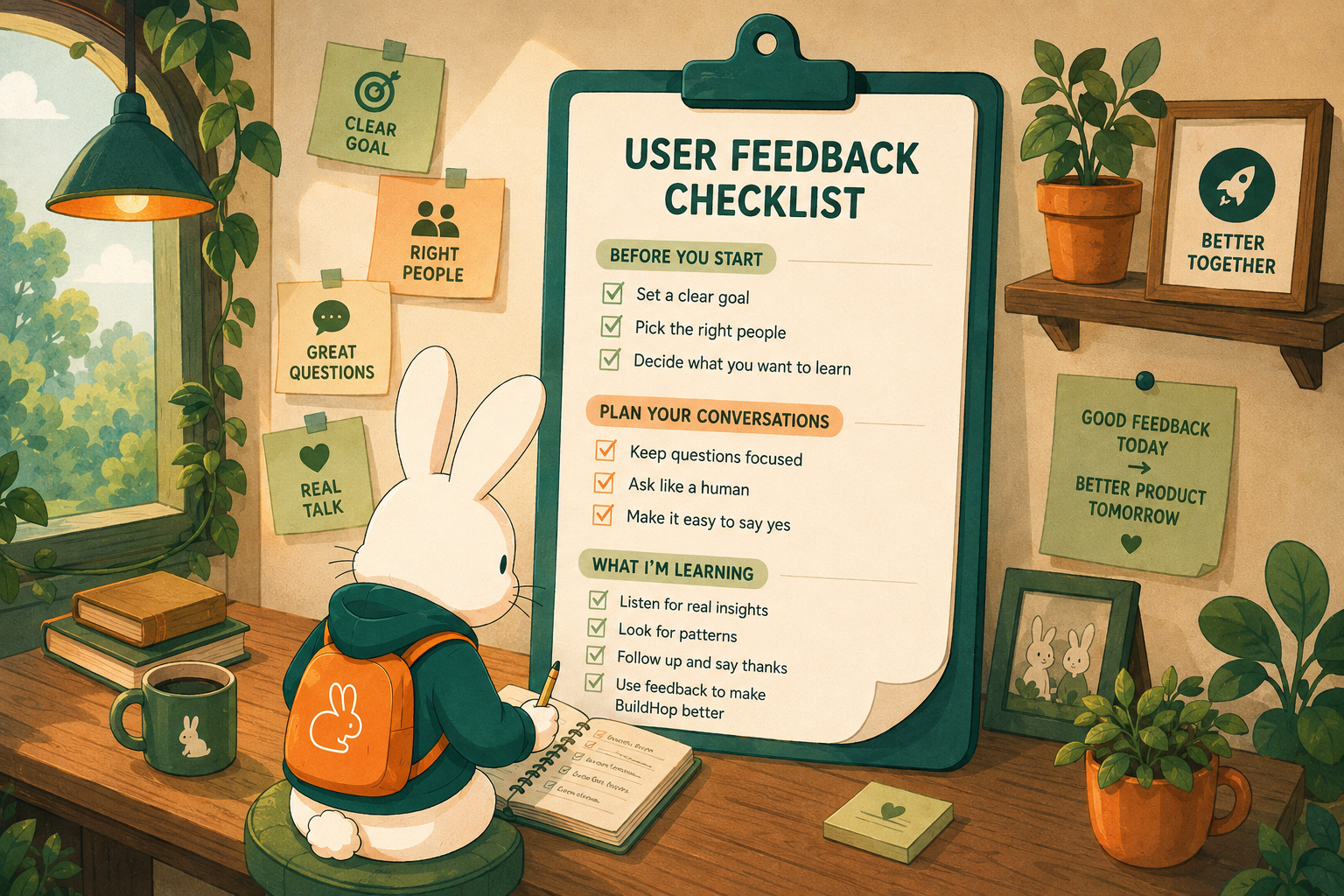
"Talk to your users" is good advice.
It is also extremely vague advice when you are staring at your computer wondering where to start.
We see it work at scale, with entire teams dedicated to user research. But how do you take that same practice and shrink it into something manageable for an already-busy founder?
You keep it simple.
This week, I set a goal for myself. In typical Claire fashion, the simpler and clearer the goal, the more likely I am to actually do it and learn from it.
The goal was one sentence:
Talk to 10 users.
I committed to the goal, posted about it for accountability, and then immediately stared at my computer screen.
Because then came the next question: how do I decide who to talk to?
I started scrolling through my feed and saw one of our more active BuildHop users. Instinctively, I sent him a message that was basically:
"OMG HI I KNOW YOU LOVE USING OUR PLATFORM WANT TO ANSWER SOME QUESTIONS?"
He has not responded yet, but he may.
After sending that slightly chaotic, overly excited message, I realized I needed more of a plan.
Start with the people who already showed up
Since this was my first time running this experiment, I decided to start with our most active users. My thinking was that they probably understand the product best because they have actually spent time using it.
So I made a little spreadsheet in a note with their names and a column for the status of each conversation.
I know there are AI tools and research platforms and fancy mechanisms for this. I use AI all the time. But for this round, I wanted to start simple.
One open note, ten users, and a whole lot of curiosity.
Figure out what you actually want to learn
Next, I needed to decide what I was going to ask.
The quality of the feedback depends, at least partly, on the quality of the questions. And I had to decide what value I wanted these conversations to provide. That part is on me.
These are core users. I am asking for their time and energy to talk about our product. That matters. You cannot constantly tap the same people for feedback and expect them to keep giving thoughtful answers forever.
So I wanted the ask to feel light, clear, and easy to answer. Here is what I came up with:
What made you come back to BuildHop more than once?
What feels most useful right now?
What feels confusing, missing, or not quite worth returning for yet?
Is there anything you wish BuildHop helped you do better?
Four questions felt manageable. Even if someone said yes but secretly did not want to spend much time on it, this felt like something they could answer without turning it into homework.
Ask like a human
Before sending the actual questions, I needed buy-in.
I have a bit of an advantage here because BuildHop serves builders in the build-in-public community, and many of the people I reached out to are people I already have some kind of relationship with. That meant I could be casual, because that is how we naturally talk.
For some people, my first message was literally:
"Sup homie? I'm working on my user research skillset and was wondering if I could ask you a few questions?"
The exact wording matters less than the principle. Ask like a human.
Prior relationship or not, the buy-in matters. If you want quality answers, you need quality relationships. And quality relationships take a little time.
Once I had the okay, I sent the actual questions:
"A few quick questions, no need to overthink them:
What made you come back to BuildHop more than once?
What feels most useful right now?
What feels confusing, missing, or not quite worth returning for yet?
Is there anything you wish BuildHop helped you do better?
You can answer as casually or bluntly as you want. We're trying to make BuildHop more useful for the people already hopping through it, so your feedback will genuinely help 🐇"
What I learned so far
I started this process this morning, and so far I have gotten five responses. Five people are still holding out.
Because I know many of them well, I can nudge a little. Not in a weird "please complete my survey" way, but in a "hey, your honest thoughts would actually help me make this better" way.
And that is the part I am learning.
User feedback does not have to start as a polished research operation. It can start with:
A clear goal
A short list of people
Four good questions
One place to track responses
Enough trust to ask honestly
That is it.
Talk to 10 users. Start there.