

Launching without an audience does not mean launching into the void. It means you need a launch plan built around small discovery moments, not one big announcement.
A lot of launch advice assumes you already have an audience:
“Send it to your email list.”
“Post it to your followers.”
“Tell your community.”
“Ask your network to support the launch.”
Lovely. Beautiful. Sparkly, even. But what if you do not have a big email list? What if your X account has 83 followers, your LinkedIn posts get three likes, and one of them is from someone you went to high school with? What if you built something useful, but you do not have a crowd waiting to cheer when you finally share it?
That does not mean you cannot launch. It just means your launch has to work differently.
When you do not have an audience, your job is not to create one giant launch moment. Your job is to create as many small discovery moments as possible. You need to put your product in places where people can find it, understand it, try it, and give you signals you can learn from.
That is distribution. Not magic. Not fame. Not shouting into the internet until the algorithm takes pity on you. Distribution is the ongoing work of helping the right people discover what you made.
First, stop treating launch day like the whole plan
A launch is a moment. Distribution is what happens before, during, and after that moment.
If you have no audience, you cannot rely on one post to carry the whole product. You need more than “I launched!” and a link. That does not mean launch day does not matter. It can still be useful. It gives you a reason to talk about the product, a deadline to prepare for, and a moment to direct attention. But launch day should not be the entire strategy.
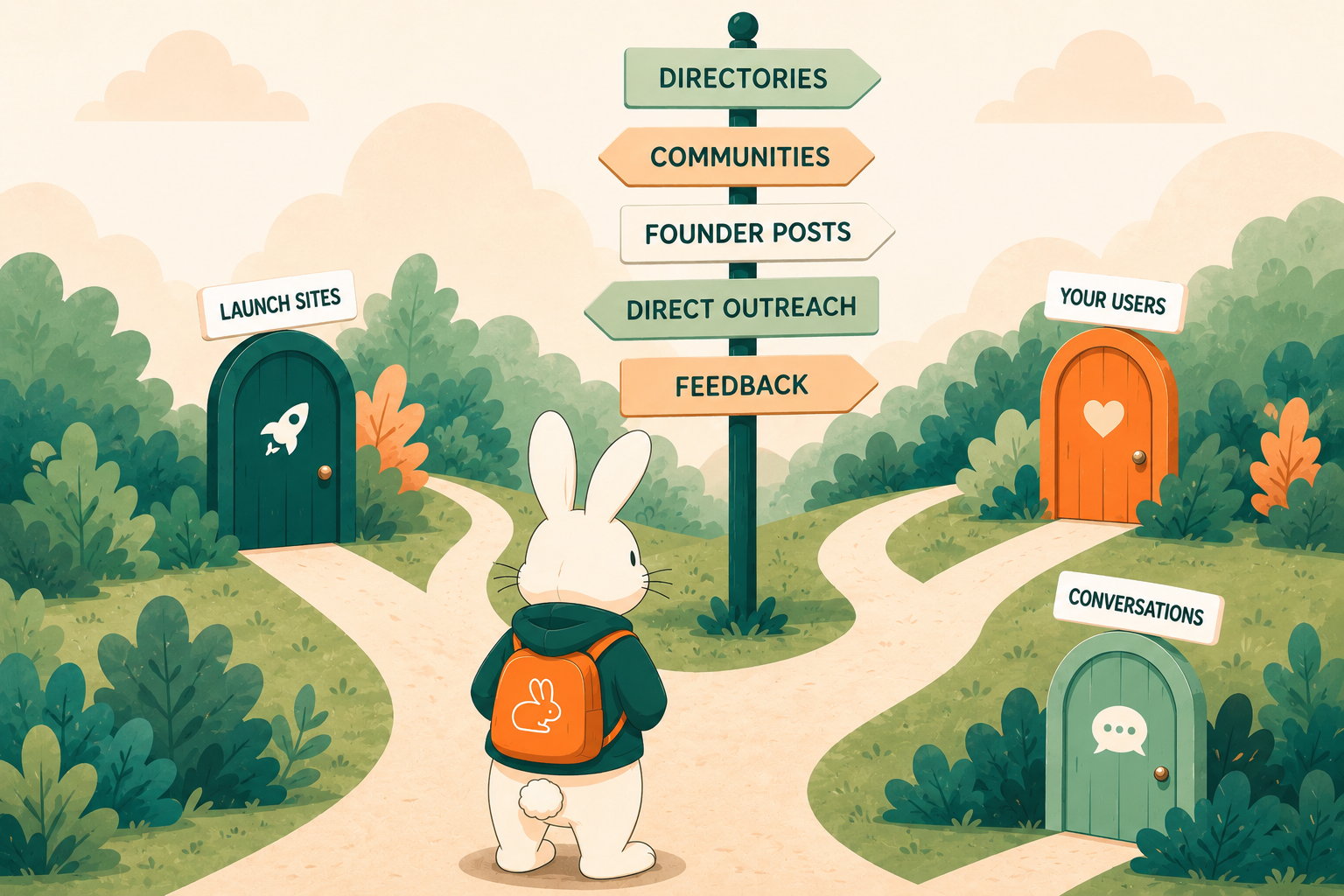
A better way to think about it: your launch is not one big door. It is a bunch of little doors. Some of those doors are posts. Some are directories. Some are communities. Some are founder conversations. Some are comments. Some are newsletters. Some are feedback requests. Some are people sharing your product because they finally understand why it matters.
When you do not have an audience, you need more doors.
Make sure strangers can understand the product quickly
Before you send people anywhere, your product page needs to do its job. Not perfectly. Clearly.
A stranger should be able to land on your page and understand four things quickly: what is this, who is it for, what does it help me do, and what should I do next? If your page does not answer those questions, launching will be much harder than it needs to be.
You do not need a huge landing page. You do not need a cinematic brand universe. You do not need twelve sections, floating cards, and a testimonial from someone named “Sarah K., Head of Growth.” You need clarity.
At minimum, your launch page should have a clear one-liner, a specific audience, a simple call to action, a screenshot or demo, a short explanation of the problem, and a reason someone should care now.
A good one-liner usually sounds like this:
Helps [specific person] do [specific outcome] without [specific pain].
For example:
Helps indie founders find better places to launch without sorting through outdated directory lists.
That is much easier to understand than:
The next-generation discovery layer for modern startup growth.
Start with the smallest useful audience
When founders do not have an audience, they often make the audience too broad. They say the product is for “teams,” “creators,” “builders,” “professionals,” or “anyone who wants to be more productive.”
That might be true eventually, but it is not very helpful at launch. If you are starting from zero, broad is expensive. Specific is easier.
Instead of asking, “How do I get everyone to care?” ask: who is the smallest group of people most likely to understand this problem?
That might be solo founders launching their first SaaS, designers collecting portfolio feedback, AI builders sharing tiny tools, newsletter writers trying to grow, developers who use a specific framework, recruiters at seed-stage startups, indie hackers building in public, or product managers at small teams.
The smaller the audience, the easier it is to find them, write for them, and explain why the product matters. You can always expand later. At launch, you need signal.
Write the launch message before you post the link
A lot of launch posts fail because they are basically just: “I built a thing. Here it is.”
That is not enough context for strangers. Before you post, write a simple launch message that explains who the product is for, what problem it solves, why you built it, what someone can do with it right now, and what kind of feedback would help.
A basic version:
I built [product] for [specific audience] who struggle with [specific problem].
It helps you [specific outcome] without [specific pain].
I built it because [short human reason].
You can try it here: [link]
I would especially love feedback on [specific thing].
This works because it gives people something to respond to. A launch post should not make people do detective work.
Share your product in more than one place
If you do not have an audience, you need borrowed discovery. That means putting your product in places where people are already looking, browsing, learning, or talking.
Here are the best beginner-friendly launch surfaces.
1. Launch sites and startup directories
Launch sites and directories are useful because the audience is already in discovery mode. People visit them to find new tools, products, apps, and projects.
You can submit to broad launch platforms, niche directories, AI tool directories, SaaS directories, indie maker lists, and product discovery feeds. The key is not to submit everywhere randomly. Look for places where the site is active, the audience matches your product, products actually get visibility, the submission process is clear, your category belongs there, and the listing gives people enough context to click.
Directories are especially useful when you do not have an audience because they give your product another surface area. Someone does not need to follow you to find you there.
This is one reason we built BuildHop. BuildHop gives builders another place to submit products, get discovered beyond one launch day, and learn from how people respond to their landing page. It is not meant to replace every other launch channel. It is one more door. And when you do not have an audience yet, one more good door matters.
2. Founder-led posts
Even if you do not have a large following, you can still post about your product. The mistake is expecting one post to do everything. Instead, create a small sequence of posts around the launch.
You can start with the problem:
“I kept noticing [specific problem], especially for [specific audience], so I started building something to help with it.”
Then share the build:
“Here is what I made, who it is for, and what it helps with.”
Then share the lesson:
“Building this taught me [specific lesson]. If you are working on [problem], this might help.”
Then make the ask:
“I am looking for feedback from [specific audience]. The main thing I want to know is [specific question].”
This gives people more than one chance to notice what you are doing. It also makes the product feel like part of a story, not a random link that fell out of the ceiling.
3. Communities
Communities can be helpful, but you have to treat them like communities, not vending machines for clicks.
Before sharing, ask whether the community is actually relevant, whether people are allowed to share projects there, what kind of posts usually get useful responses, whether you can contribute something besides a link, and whether your feedback ask makes sense for that group.
A better community post usually looks like this:
I built this because I kept running into [specific problem].
It is for [specific audience].
I am trying to understand whether [specific assumption] is true.
Would love feedback on [specific part], especially from anyone who has dealt with this.
That is much better than “Just launched! Please support!” People are more willing to help when the ask is clear and the product is relevant.
4. Direct outreach
Direct outreach is underrated, especially at the beginning. When you do not have an audience, you can still talk to real people one by one.
The key is to make it specific and respectful. Bad outreach feels like a copy-paste net thrown into the sea. Good outreach feels like you chose the person for a reason.
A simple message:
Hey [name], I saw you are working on [specific thing].
I built [product], which helps [specific audience] with [specific problem].
Thought it might be relevant because [reason].
No pressure at all, but I would love your feedback if you are open to taking a look.
Do not send this to 500 random people. Send it to a small number of people who might actually understand the problem. At the early stage, a thoughtful reply from the right person can be more useful than a silent traffic spike.
5. Comments and replies
If you do not have an audience, replies can be more useful than posts. Find people already talking about the problem your product solves, then join the conversation in a way that is actually helpful.
Do not immediately drop your link. Add something useful first. Share a lesson, answer a question, offer a resource, explain how you are thinking about the problem, ask a thoughtful follow-up, or mention your product only if it is truly relevant.
A good reply can put you in front of the right people without needing your own huge platform. This is not about being everywhere. It is about being useful in the places where your users already are.
Give people a reason to help
When you have no audience, your first supporters are usually people who feel some reason to care. They may relate to the problem, like seeing early products, want to support builders, be curious about the category, know someone who needs it, want to give feedback, or enjoy being early.
Make it easy for them. Instead of only saying, “Please check this out,” try asking for something more specific.
For example:
"I would love feedback on whether the landing page makes sense."
"If you know someone trying to solve [specific problem], feel free to send this their way."
"I am trying to find the first 10 people who have this problem."
Specific asks are easier to answer. Vague asks float away into the internet fog.
Pay attention to signals, not just numbers
A launch without an audience might not produce huge numbers. That is okay. At this stage, you are looking for signal.
Pay attention to who clicks, who replies, who signs up, who asks questions, who shares it, where people get confused, what words people repeat back to you, which channels bring the best-fit visitors, whether people understand the product, and whether anyone comes back.
A post with 12 likes and 3 useful conversations might be better than a post with 500 likes and zero relevant users. Traffic is nice. Learning is better. The goal of an early launch is not only attention. It is information.
Keep going after launch day
The most important thing to do after launch day is not disappear. A lot of founders launch, feel disappointed, and immediately move on. But launch day is just the first signal.
After you launch, you can keep going. Submit to more relevant directories. Post what you learned from the launch. Share a demo clip. Write a short founder note. Ask for landing page feedback. Turn questions into content. Follow up with people who showed interest. Improve your one-liner. Test a new audience. Try a new community. Publish a simple guide related to the problem.
Most products are not discovered all at once. They are discovered through repeated exposure, clearer messaging, better surfaces, and small moments that compound.
A simple launch plan if you have no audience
Here is a beginner-friendly version.
Before launch
Choose one specific audience. Write a clear one-liner. Make sure your landing page explains what the product does. Prepare 3 to 5 launch posts from different angles. Make a list of relevant directories, communities, and people to reach out to. Decide what kind of feedback you want.
Launch day
Publish your main launch post. Submit to one or more relevant launch sites or directories. Share in one community where the product genuinely belongs. Reach out to a small number of relevant people. Reply to every thoughtful comment. Track clicks, signups, replies, and questions.
After launch
Share what you learned. Fix the confusing parts of your landing page. Keep submitting to relevant places. Turn feedback into better messaging. Post demos, examples, and use cases. Ask better questions. Keep finding new rooms where your product belongs.
That is the real work. Not one perfect launch. A repeatable discovery loop.
Final thought
You do not need a huge audience to launch a startup. You need clarity, relevance, and a willingness to keep putting the product where the right people already are.
Start small. Find the people who understand the problem. Make the product easy to understand. Use directories, communities, posts, replies, outreach, and feedback to create more discovery moments. Then learn from what happens.
No audience does not mean no chance. It just means your launch cannot depend on applause. It has to depend on distribution.
