

Launching feels like the finish line. It is not.
You spend weeks building, polishing, fixing, recording, writing, and getting everything ready. Then launch day arrives. You share the link. For a few hours it feels like the whole thing is finally out in the world.
Then the spike fades.
This is where a lot of founders get stuck. Not because the product is bad, and not because the launch failed, but because they treated launch day like the entire distribution plan.
A launch is a moment. Distribution is what happens before, during, and after that moment.
A good distribution checklist gives your product more than one chance to be seen, understood, clicked, tested, shared, and improved. You do not need a giant marketing machine to start. You need a clear plan for where your product is going, what you are saying about it, and what you will do with the attention you get.
Here is a practical checklist you can use at every stage.
Before you launch
Distribution starts before the announcement post. Before you send people anywhere, make sure the basics are in place. More traffic will not help if people land on the page and cannot tell what the product does, who it is for, or what they should click next.
1. Write a clear one-liner
Your one-liner should explain your product in plain language. A good one usually answers three things: who it is for, what it helps them do, and why that matters.
For example:
"BuildHop helps founders get their products discovered after launch day."
That is much easier to understand than:
"BuildHop is a next-generation discovery ecosystem for startup visibility."
The goal is not to sound impressive. The goal is to help people understand. Write a one-liner you can use on your landing page, in social posts, in DMs, in directory submissions, and anywhere else you need to explain the product quickly.
2. Make sure your landing page passes the five-second test
Most visitors do not read your landing page carefully at first. They glance, orient themselves, and decide whether they understand enough to keep going.
Before you send more people to the page, make sure the first section answers the basics: what is this, who is it for, what does it help me do, why should I care, and what should I click next?
You do not need a perfect landing page to launch. You need enough clarity for a stranger to understand the point without needing the founder's backstory.
3. Prepare more than one launch angle
A lot of founders write one launch post and then feel awkward repeating themselves. The fix is not to disappear after launch day. The fix is to prepare multiple angles ahead of time.
You can talk about the same product from different directions: the problem it solves, the reason you built it, the first use case, the audience it is for, the lesson you learned while building, the feature you are most excited about, or the feedback you want from early users.
This gives you several ways to share the product without posting the same announcement over and over.
4. Make a list of places to share it
Do not wait until launch day to figure out where your product should go. Make the list ahead of time. Include a mix of places that serve different goals: early users, founder feedback, backlinks, niche discovery, community discussion, and social proof.
Your list might include your own social accounts, founder communities, relevant Slack or Discord groups, startup directories, niche directories, newsletter submission forms, subreddits where sharing is allowed, indie hacker communities, BuildHop, or other product discovery feeds.
The goal is not to submit everywhere at once. The goal is to avoid putting the entire launch on one post, one platform, or one lucky algorithmic sneeze.
5. Decide what kind of feedback you want
"Any feedback?" sounds open. It often makes people do too much work.
Before you launch, decide what you actually want to learn. You might ask:
"Can you tell what this does within five seconds?"
"Is the CTA obvious?"
"What would stop you from signing up?"
"What part of the page feels confusing?"
Specific questions make feedback easier to give and more useful to receive.
During launch
Launch day is not just about posting the link. It is about creating the first few loops of attention, conversation, and learning.
6. Share the clearest version first
Your first launch post should make the product easy to understand. Say what you built, who it is for, what it helps them do, and where to try it. Add story and personality, but do not bury the point. People should not have to read five paragraphs before they know what the link is.
7. Reply to everyone who engages
The first people who comment, reply, ask questions, or share your product are part of your earliest distribution loop. Do not treat replies like confetti.
If someone asks a question, answer it. If someone gives feedback, learn from it. If someone misunderstands the product, notice exactly where the explanation broke. If someone shares it, keep the conversation going.
Early engagement is not just vanity. It shows you what people understand, what they care about, and what needs to be clearer.
8. Save useful reactions and questions
Keep track of what comes back. Save the questions people ask. Save the phrases they use to describe the product. Save objections, compliments, confusion, and the things people repeat.
These reactions can turn into better landing page copy, stronger positioning, future posts, FAQ sections, product improvements, and follow-up messages. Distribution is not only about sending information out. It is also about listening to what comes back.
9. Ask for one specific action
Do not ask people to do five things at once. A launch post that asks people to try it, share it, give feedback, join a waitlist, and send it to a friend creates decision soup.
Pick the most important action for that moment and ask for that.
After launch
This is where distribution usually gets interesting. Launch day creates the first wave of attention. The days after are where you turn that attention into learning, updates, and continued visibility.
10. Share what happened
Post a simple recap. You do not need dramatic metrics. Share what you learned, what surprised you, what feedback you received, what you are changing, or what people seemed to care about most.
This helps people follow the story. It also gives you a reason to talk about the product again without repeating the launch announcement.
11. Improve the page based on what people misunderstood
If people keep asking the same question, your page may need to answer it earlier. If people describe the product incorrectly, your headline or subheading may need to be clearer. If people like the idea but do not try it, you may need more trust, a better demo, or a clearer promise.
Use the first wave of attention to improve the second wave.
12. Submit to more places slowly
You do not have to launch everywhere on the same day. Slower distribution can actually be better. It gives you time to learn from each place, improve the page, refine the pitch, and see which audiences respond.
Start with a few relevant places. Watch what happens. Then keep going.
13. Turn feedback into follow-up content
Every useful piece of feedback can become a new post. If someone asks who the product is for, write a post explaining the use case. If someone points out a confusing part of the page, share what you changed. If someone gives a strong reaction, share the lesson.
This is how distribution gets easier over time. You stop inventing content from nothing and start turning real signals into useful updates.
14. Keep showing up after the spike fades
The hardest part of distribution is not launch day. It is continuing after the first wave of attention is gone.
That does not mean posting the same link every day. It means continuing to give people new reasons to understand the product. Share improvements, lessons, use cases, small wins, changes, and what you are testing next.
A product usually needs more than one encounter before people remember it. You are not being annoying by continuing to talk about what you built. You are being annoying only if every post says the same thing with no new context.
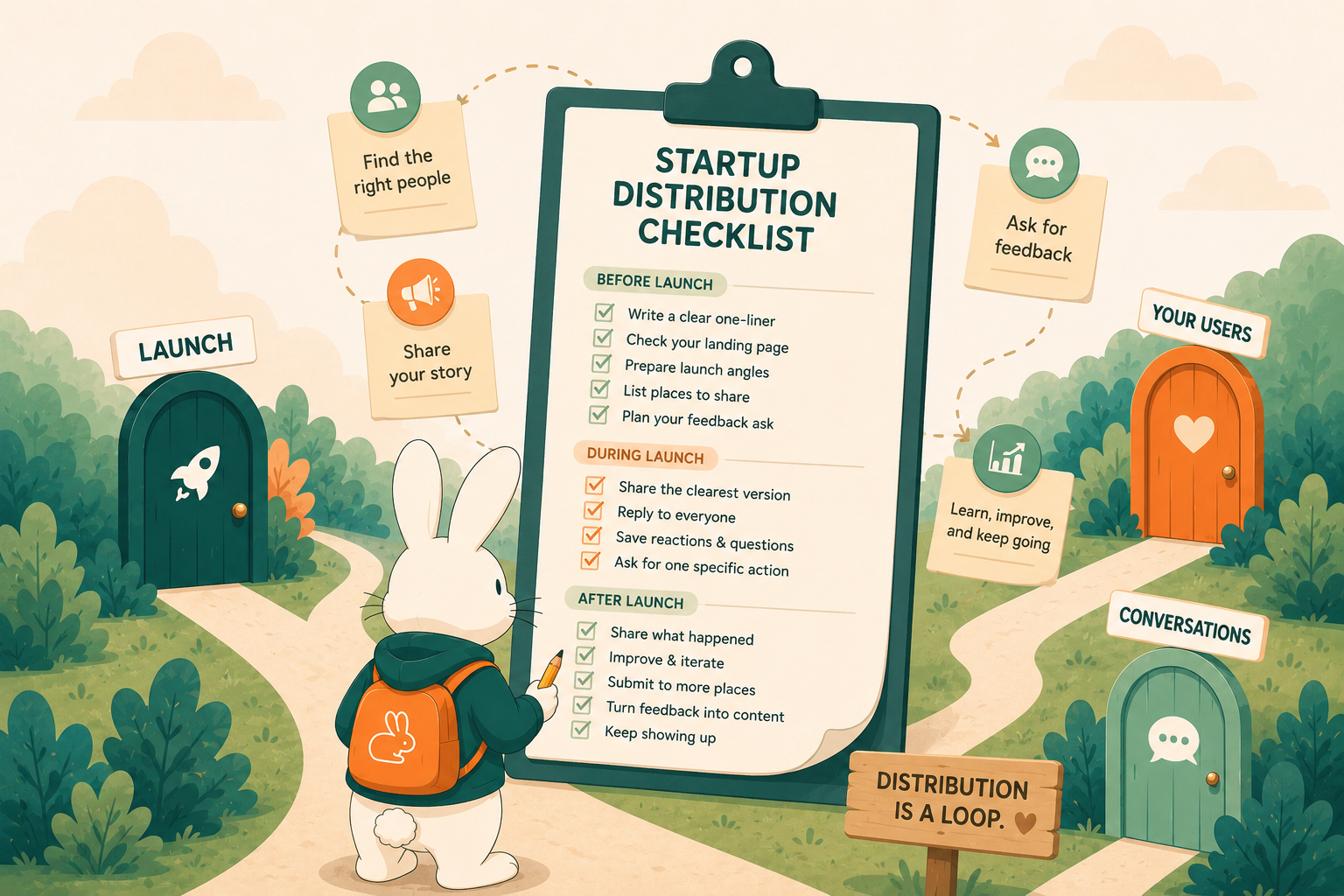
A simple distribution checklist
Before launch
Choose one specific audience. Write a clear one-liner. Make sure your landing page passes the five-second test. Prepare more than one launch angle. Make a list of places to share. Decide what kind of feedback you want.
During launch
Share the clearest version first. Reply to everyone who engages. Save useful reactions and questions. Ask for one specific action.
After launch
Share what happened. Improve the page based on what people misunderstood. Submit to more places slowly. Turn feedback into follow-up content. Keep showing up after the spike fades.
Distribution is a loop
A good launch gives your product a first moment of attention. A good distribution plan gives that attention somewhere to go.
You do not need a giant audience. You do not need a perfect launch. You do not need to be everywhere at once.
You need a clear product, a clear page, a few good places to share it, and a way to learn from what happens next.
Not one post. Not one spike. Not one launch day.
A loop.
