


Launch day gets a lot of attention.
You plan the post. You update the landing page. You submit to the launch platforms. You ask friends to support it. You refresh your analytics more than any reasonable person should refresh their analytics.
And then, for a little while, it works.
People visit. A few people click around. Maybe someone signs up. Maybe someone leaves feedback. Maybe someone shares it. Maybe you get that nice little spike that makes you feel like the whole thing was worth it.
But then the spike fades.
This is the part of launching that people do not talk about enough.
Your launch can go well and still not create ongoing traffic. That does not mean the launch failed. It means launch day is not the whole distribution system. It is one moment of attention.
If you want people to keep finding your product after launch day, you need more than a single announcement. You need repeated discovery moments.
Launch day is a spike, not a strategy
A launch is useful because it gives your product a clear moment in time. It gives you a reason to talk about what you built. It gives people a reason to pay attention now.
That matters.
The problem starts when launch day becomes the entire plan.
A founder spends weeks building the product, a few days preparing the launch, one day posting everywhere, and then the product quietly disappears under the next wave of new things.
Social feeds move fast. Launch platforms move on. Communities keep scrolling. Even people who were interested may forget to come back.
That does not mean your product was not good. It means attention has a short shelf life unless you create more ways for people to find you.
The goal is not to keep relaunching the same product forever. The goal is to keep giving the right people new doors into it.
Your product needs more than one discovery path
People do not all discover products the same way.
Some people find tools through search. Some find them through founder posts. Some find them through directories. Some find them because someone mentioned it in a reply. Some find them through backlinks, newsletters, roundups, community threads, comparison posts, or product collections.
A launch gives you one discovery path. Post-launch distribution gives you many.
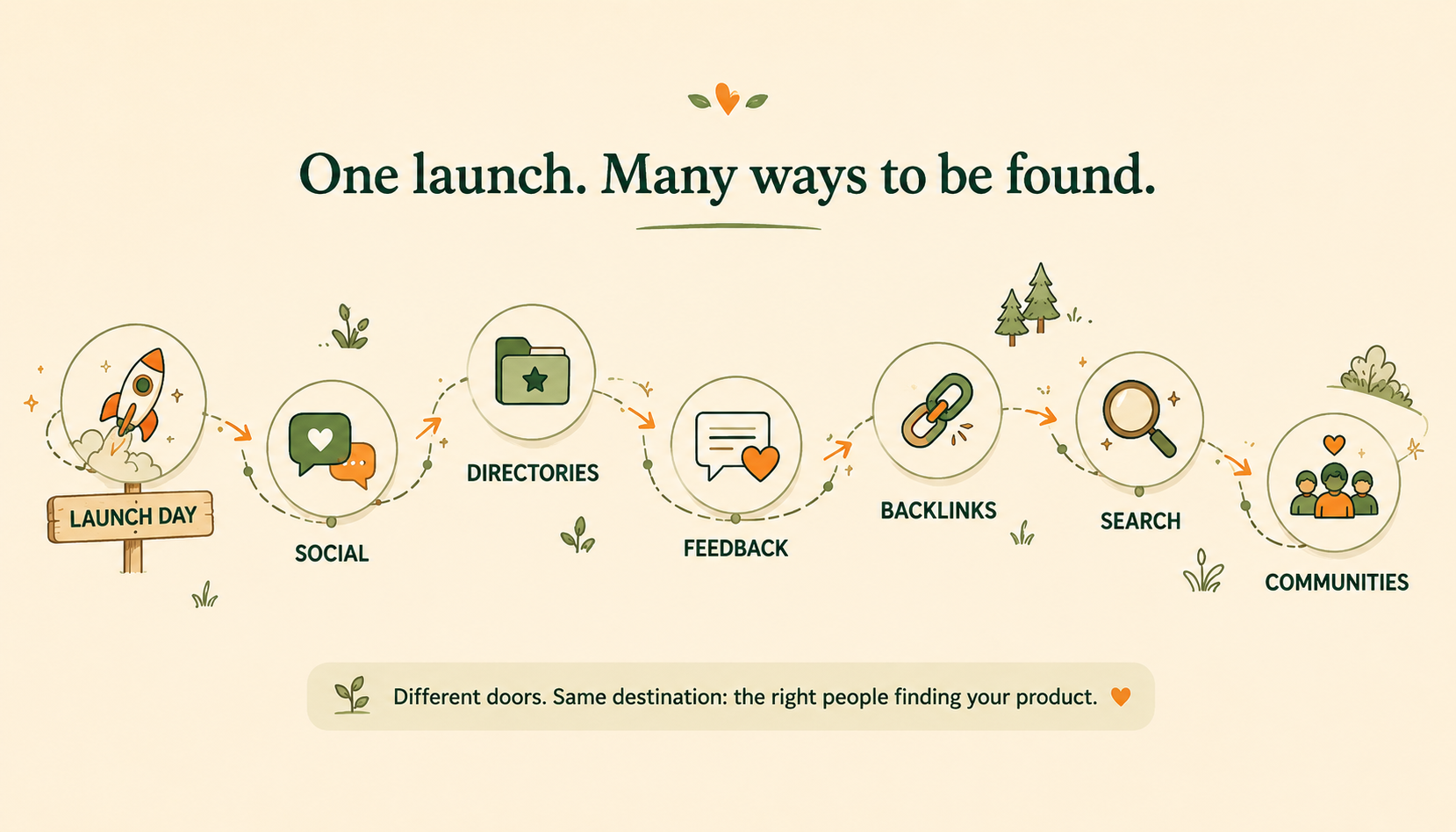
That is the real shift. Instead of thinking, “How do I get one big wave of traffic?” you start thinking, “Where can this product keep being found?”
That might mean submitting to directories. It might mean writing helpful posts around the problem your product solves. It might mean sharing updates every time you improve something meaningful. It might mean collecting feedback publicly. It might mean turning customer questions into content. It might mean showing up in communities where people already talk about the problem.
None of these have to be huge on their own. The point is that they compound.
One post can disappear. Ten small discovery paths are harder to miss.
Turn your launch into reusable content
A lot of founders post once about launching and then feel like they have nothing else to say.
But your launch is not one piece of content. It is the beginning of a whole set of stories.
You can talk about why you built the product. You can talk about who it is for. You can explain the problem it solves. You can share what changed from the first version to the current one. You can show what surprised you. You can share early feedback. You can explain what you are improving next.
You can also talk about the problem without always talking about the product.
That part matters.
If your product helps founders collect feedback, you can write about why feedback is hard to ask for. If your product helps people create landing pages, you can write about what makes landing pages confusing. If your product helps people find better tools, you can write about how discovery is broken.
The product is one answer inside a larger conversation.
When you treat the launch as the start of that conversation, you create more chances for people to find the product later.
Submit your product where people browse after launch day
Launch platforms are useful, but they are not the only places people discover products.
Directories, founder communities, curated collections, newsletters, and discovery feeds can keep sending attention long after the launch post is buried.
This is especially useful for early products because most founders do not have a large audience yet. If you are relying only on your own social reach, you are limited by who already knows you exist.
Submitting your product to the right places gives it more surface area.
The key is to be thoughtful. You do not need to submit everywhere. You need to submit to places where your product makes sense and where people might actually browse for something like it.
A niche directory with the right audience can be more useful than a giant list where your product gets buried. A founder community where people leave real feedback can be more valuable than a place that only gives you a logo and a link. A discovery feed that people revisit can matter more than a one-time announcement.
The best post-launch distribution does not just chase traffic. It creates more chances for the right people to bump into your product.
Collect proof while people are paying attention
When people first visit your product, they are giving you more than traffic. They are giving you signals.
They may leave feedback. They may ask questions. They may tell you what confused them. They may share what made them click. They may mention the product somewhere else. They may describe the problem better than you did.
Do not let those signals disappear.
Early feedback can become product improvements. Good comments can become testimonials. Repeated questions can become landing page copy. A useful reply can become a blog post. A mention can become social proof. A backlink can help your product build authority over time.
This is one of the biggest differences between a launch spike and a distribution loop.
A launch spike gives you attention once.
A distribution loop turns that attention into assets you can use again.
Keep giving people new reasons to care
After launch day, a lot of founders worry that posting about the product again will annoy people.
But there is a difference between repeating the same announcement and creating new entry points.
“Here is my product” gets old quickly.
“Here is what we learned from our first users” is different.
“Here is the feature we added because people kept asking for it” is different.
“Here is the mistake we made on our first landing page” is different.
“Here is how we are thinking about the problem now” is different.
You are not asking people to care about the same thing over and over. You are giving them more context, more proof, and more reasons to understand why the product matters.
People often need to see something more than once before they pay attention. That does not mean you need to be loud. It means you need to be consistent.
Build a simple post-launch rhythm
Keeping traffic going after launch day does not require a giant marketing machine.
You can start with a simple rhythm.
Submit your product to one or two relevant places each week. Share one useful post about the problem your product solves. Turn one piece of feedback into an improvement or a public update. Look at where traffic came from. Keep the channels that work. Drop the ones that do not.
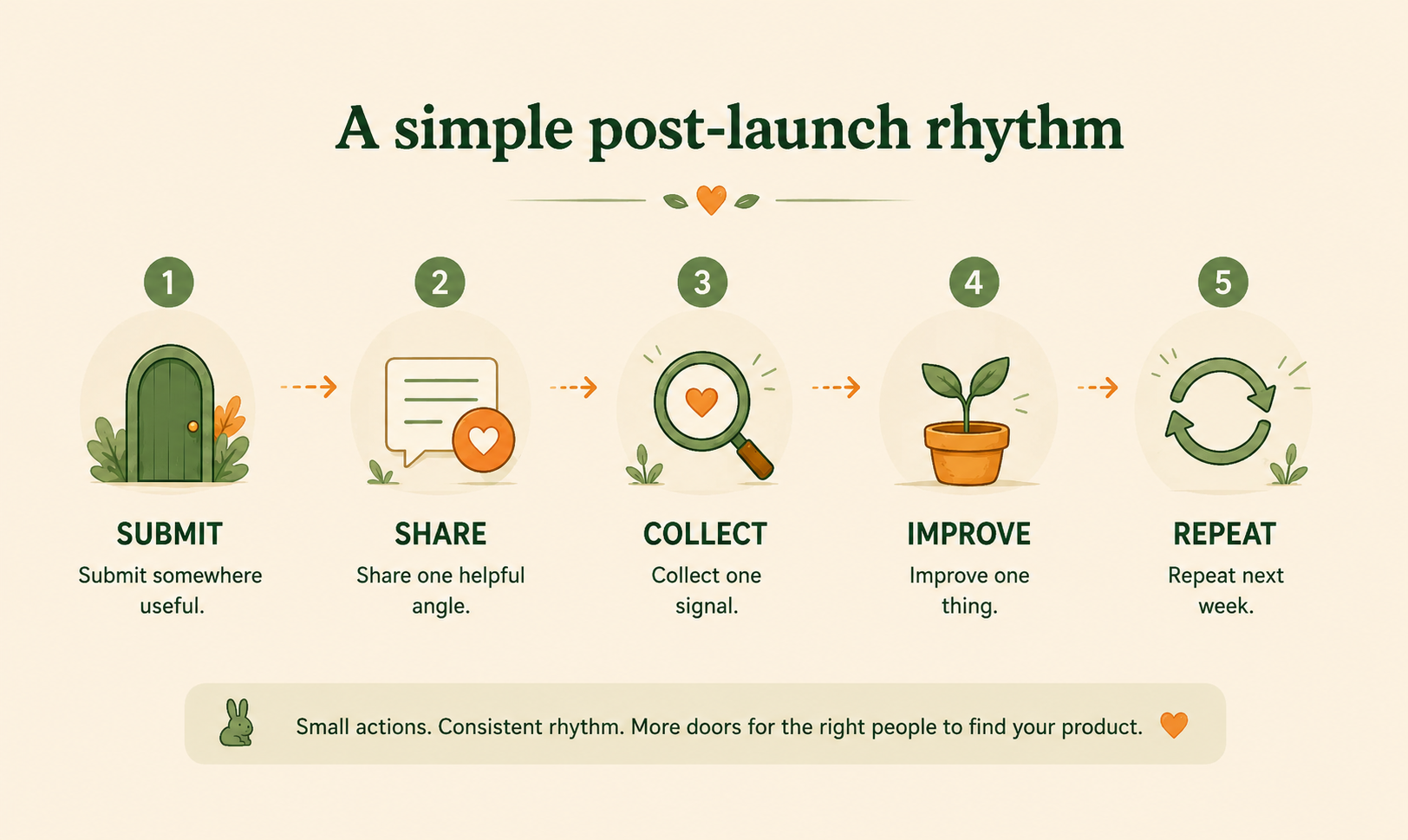
That is enough to start.
The goal is not to do everything at once. The goal is to avoid letting the product go silent.
A product that keeps showing up in small, useful ways has a better chance of being found than a product that only appears on launch day and then vanishes.
Make your product easier to find later
The best post-launch traffic often comes from things you did before the person was ready to click.
Maybe they saw your product in a directory two weeks ago. Maybe they read a post you wrote. Maybe they noticed someone else mention it. Maybe they found your landing page through search. Maybe they saw your product appear again in a discovery feed and finally decided to check it out.
That is what you want.
You want your product to keep leaving little open doors around the internet.
BuildHop exists for this reason. Not every product gets discovered on launch day. Not every founder has a giant audience. Not every useful thing gets attention the first time it is posted.
A product deserves more than one shot at being seen.
Launch day can introduce your product to the world. Post-launch distribution helps people keep finding it.
So after the launch spike fades, do not assume the moment is over.
Keep creating discovery moments. Keep collecting signals. Keep improving the product. Keep showing people why it matters.
Your launch was the first door. Now build the trail.
